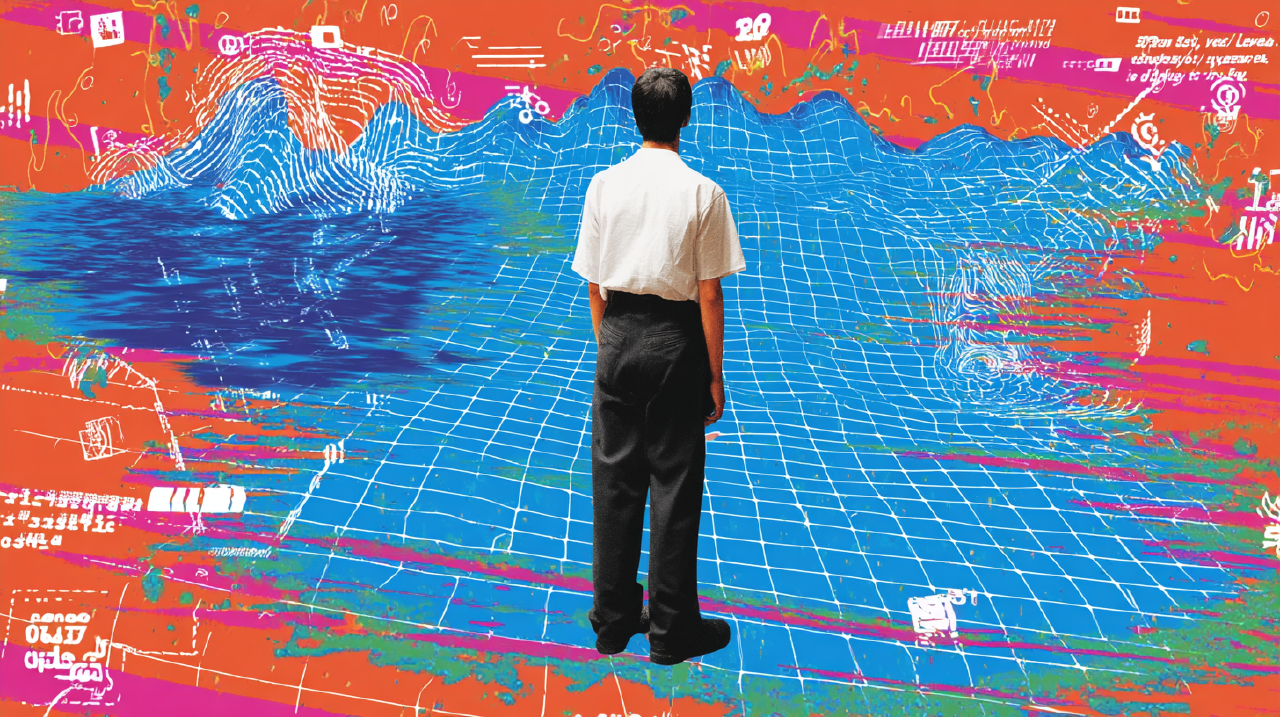


At 7:42 a.m., a commuter stands inside a moving train and does what people do now when forced to be still.
Thumb down. Thumb down. Thumb down.
A video ends, another starts. The hand barely moves. The mind moves less. Fifteen seconds here, twenty there. Small cuts, no seams, no edges. It feels like getting somewhere.
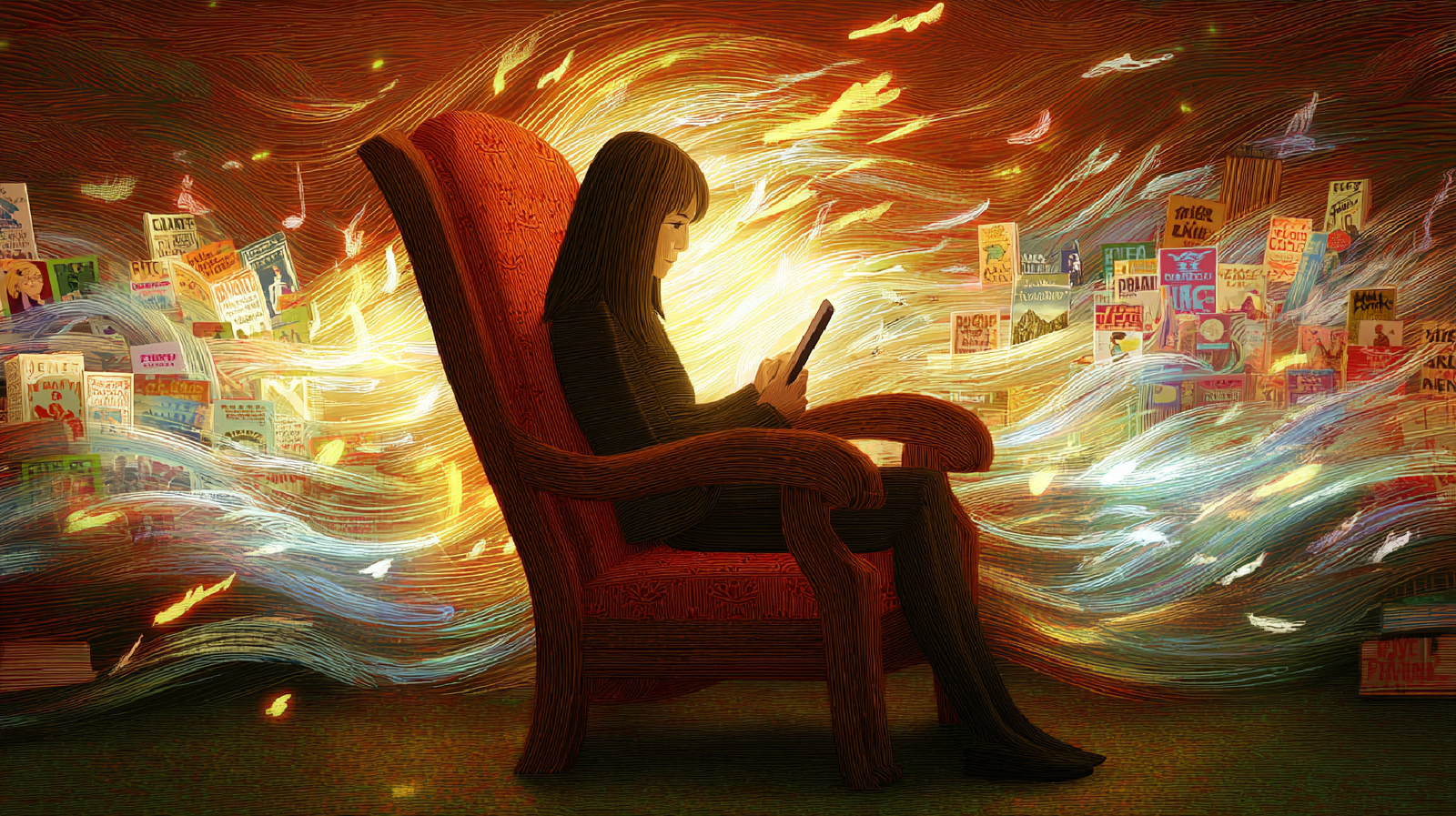
At 7:58 a.m., the same commuter switches apps. An audiobook. The voice is calm, the sentence takes its time, the body exhales. Spotify lets the listening run, but not forever; in some markets, it comes with an hour budget. The book has chapters. The chapters end. The story doesn’t pretend to be infinite.
By lunch, a newsletter arrives. Once a week. No backscroll. No “you missed 63 posts.” A single drop, like a supply cache left on the trail.
This isn’t a personality type. This is most people now. They flip tempos. They speed-run the feed, then look for somewhere to land. Sometimes both before coffee.
The internet isn’t becoming slow. It is becoming bimodal. Fast when it works. Slow when it has to. And slow media is arriving as a design correction, guardrails added after enough cars drifted off the same bend.
Infinite scroll deleted the decision point Link to heading
A page used to end. Ending meant choice. Continue or stop. Turn the page or close the book. Stand up, get water, look out the window, remember what the last paragraph said.
Infinite scroll deletes that moment.
Nielsen Norman Group notes the trade-off: infinite scrolling lowers interaction cost and raises engagement. Efficient. Keeps people moving. Also changes what “browsing” feels like, because the interface stops asking for choices at natural boundaries. 2
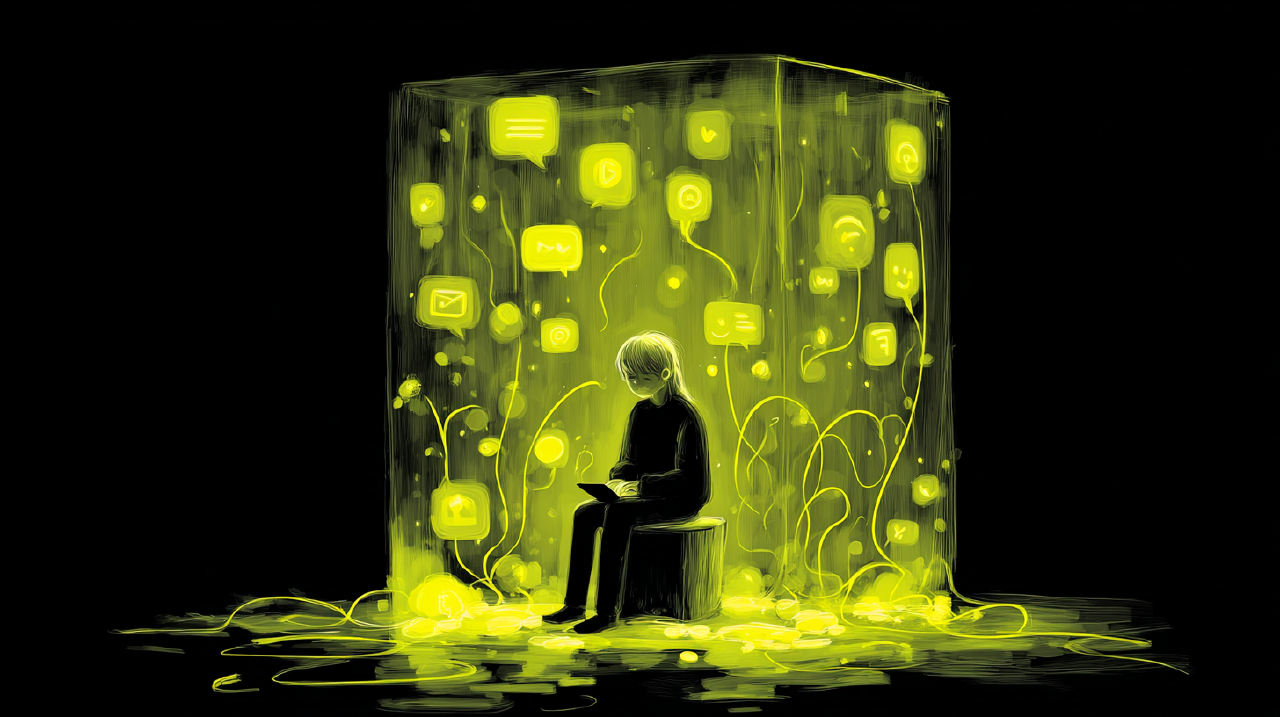
Add personalization, add autoplay, and the system becomes a conveyor belt that adjusts speed to the person standing on it.
The Washington Post tracked this with TikTok usage data from over 800 U.S. users. “Light” use drifted heavier over time. In-app tools meant to slow people down, like “take a break” reminders, were among the most skipped because rest does not stand a chance when it shows up as a nag screen in the middle of a current. 1
Speed solved real problems. Discovery got cheaper. Boredom got treated quickly. Niche culture found audiences without permission. People learned in fragments while waiting in lines.
Speed also created a new problem: a culture that struggles to finish.
A feed that never ends trains attention to behave the same way. Always moving. Rarely arriving.
The cost isn’t time. It is memory. Link to heading
Most debates about “doomscrolling” get stuck at hours. Wrong instrument.
Fast media is optimized for momentum, not retention. Engineered to feel busy while leaving little behind.
A 2024 study names part of this: “normative dissociation,” a state of absorption that reduces self-awareness and disrupts memory, connected to design features like infinite scroll. The researchers tested a simple intervention: a feed where users had to react to each post before seeing more. People remembered more posts afterward. Many also found it frustrating. 3
That result is inconvenient in a productive way.
Two things can be true: the frictionless feed impairs recall, and friction applied like a toll booth feels bad.
The lesson isn’t “make everything harder.” The lesson: a stop cue has to feel like a handhold, not a punishment.
Slow media, at its best, isn’t about scolding people for liking speed. It is about restoring the terrain features that let a human mind orient itself.
Edges. Chapters. Landmarks. The chance to stop without feeling like failure.
Slow media isn’t nostalgia. It is a different contract. Link to heading
The Slow Media Manifesto dates to 2010, which is embarrassing for anyone calling this a new trend. Its claims are blunt: slow media promotes monotasking, aims for quality, treats slowness as discipline rather than vibe. 5
Read it now and it feels less like a manifesto, more like an early warning label.
The point isn’t returning to an analog past. The real move is building digital experiences that respect a constraint: attention needs shape to make meaning.
Shape requires boundaries.
A bounded thing can be good. A boundless thing can be useful. A boundless thing can also be a trap.
The last decade taught platforms how to remove boundaries with surgical precision. The next looks like a messy, uneven effort to put some back.
Three design moves, three levers Link to heading
Slow media is easy to romanticize in the abstract. It gets real when it shows up as a product decision that costs money, costs reach, or costs “engagement.”
Glass calls itself a paid community for photographers. The membership page spells it out: “No ads or engagement algorithms.” $39.99 a year. 6 This is slow media by economics. If a company doesn’t sell attention, it doesn’t need to manufacture addiction. A subscription doesn’t magically create depth, but it changes the incentive map. It makes “calm” legible as a product requirement.
Tonic launched as a personalized news reader with privacy-first architecture. TechCrunch reported that behavioral data stayed on-device; the company never sees it. 7 “Slow” isn’t always about pace. Sometimes it’s about terms. People don’t mind recommendations. They mind being watched. Tonic is also a reminder that building humane alternatives is hard; some will be acquired, folded, or shut down. The trail still matters. It shows where the ground is solid.
Spotify is no slow media poster child. Global habit machine. Aggressive personalization. But it’s experimenting with something that looks like a soft correction: bounded personalization. Daylist updates multiple times daily, but tells you when the next update comes. That timestamp is a boundary that turns the algorithm from an endless slot machine into something closer to scheduled programming. 8 Its audiobook offering includes 15 hours per month: a budget, not infinity. 9
So it looks like even Spotify is rediscovering the value of edges and controlled friction!
The metric shift Link to heading
Fast feeds are judged by time spent, daily active users, and throughput numbers that treat attention like a liquid to be pumped.
Slow media asks a different question: Did anything stick?
That’s why newsletters, long-form audio, and “read it later” tools keep resurfacing. They produce different artifacts: replies, saves, highlights, revisits.
Even the old metrics are getting unreliable. Mailchimp publishes benchmarks suggesting email senders aim around a 34% open rate. 12 Twilio SendGrid warns that Apple’s Mail Privacy Protection inflates open rates and encourages looking beyond opens to clicks and conversions. 13
When the dashboard lies, people look for sturdier instruments.
Slow media grows where measurement rewards depth instead of compulsion.
The equity problem Link to heading
Here’s the uncomfortable part that slow media fans step around.
A lot of the “slow” internet is paid.
Pay $39.99 and get “no engagement algorithms.” Pay for newsletters. Pay for nicer reading apps. Pay to escape the feed.
That can turn slow media into the digital version of a gated overlook: beautiful view, limited access.
Safiya Noble’s Algorithms of Oppression argues that search engines aren’t neutral and can reinforce racism while presenting themselves as an equal playing field. 14 Ruha Benjamin’s Race After Technology describes how technologies encode and reproduce inequality, what she calls the “New Jim Code.” 15
If the default digital environment already distributes harm unevenly, then “just log off” and “just pay for calm” aren’t serious solutions. They are escape hatches for those most able to use them.
And the business model underneath: Zuboff’s work on surveillance capitalism describes a system built to mine personal data to predict and shape behavior. Much of the modern internet is funded by turning attention into a commodity. 16
In that world, speed isn’t an accident. It is revenue.
So the equity question for slow media isn’t “Can some people find a quieter corner?”
It is: Can the default environment be redesigned so relief isn’t a luxury good?
That points toward design moves that don’t require a paywall:
- Real stop cues by default: finite scroll options, “load more” boundaries, session summaries.
- Personalization that doesn’t require full surveillance: on-device learning, data minimization.
- User-set pacing controls that show up as normal settings, like choosing a transit route, not guilt prompts.
A humane internet isn’t one where everyone goes slow all the time.
It is one where people can choose tempo without being coerced by invisible incentives.
Signals on the ridgeline Link to heading
Five that look real:
Research is shifting from “time spent” to “what people remember.” The 2024 study linking infinite scroll to dissociation and testing recall is part of a broader move: measuring cognitive outcomes, not just engagement. 3
Designers are prototyping finite feeds as a first-class pattern. “Purpose Mode” describes a homepage finite scroll that replaces infinite loading with a “show more” boundary, a stop cue built into the page, not pasted on top. 4
Subscriptions prove there’s a market for calm. Glass: pay money, get photos, skip algorithms. The contract is explicit. 6
Mainstream platforms are quietly reintroducing limits. Spotify’s daylist has scheduled updates. Its audiobook offering uses a monthly budget. The big system admitting “infinite” isn’t always a feature. 8 9
Participation is cooling. Morning Consult suggests Gen Z adults are among the least likely to post daily on their favorite platforms. When posting becomes rarer, gravity shifts from “perform for the feed” toward “consume, reflect, share selectively.” 10
A tipping point, if it comes, won’t look like a march.
It will look like defaults changing. Stop cues becoming normal. Platforms competing on trust and memory, not hours extracted.
The highway and the lane Link to heading
Speed-run media will keep winning where it wins.
During a commute, fast clips can be relief. During a hard week, a scroll can numb a nervous system with no spare capacity. Speed is sometimes mercy.
The warning is that a culture built mostly on speed becomes oddly hollow. Good at reacting. Bad at remembering. Trading perspective for throughput. Like living in a city where every street is a highway.
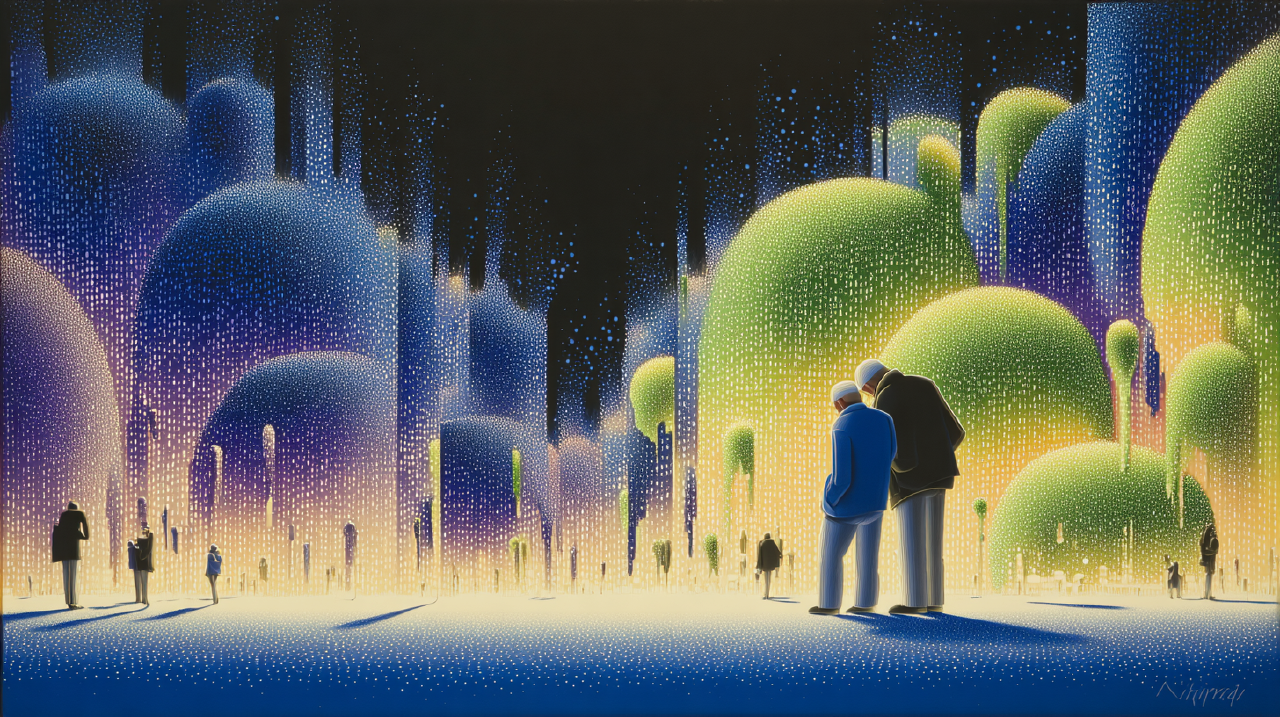
Slow media is like adding the scenic road back in and when you have the time and state of mind to drive it, it’s bliss. I guess that’s the point.
The commuter on the train doesn’t need a lecture. The commuter needs options honest about what they do.
A feed that ends. A playlist that waits. A book with a budget. A letter that lands.
None of this requires costume. It requires a simple idea that modern systems forgot and are now relearning:
People don’t only need content.
People need places to stop.
Sources
- How TikTok keeps its users scrolling for hours a day The Washington Post (2025). 1
- Infinite scrolling: When to use it, when to avoid it Nielsen Norman Group (2022). 2
- Design frictions on social media: balancing reduced mindless scrolling and user satisfaction Ruiz, Molina León, Heuer (2024), arXiv. 3
- Purpose Mode: Reducing distraction through toggling… ACM Digital Library (2025). 4
- The Slow Media Manifesto Sabria David, Jörg Blumtritt, Benedikt Köhler (2010). 5
- Membership (pricing and “no ads or engagement algorithms”) Glass (n.d.). 6
- Tonic launches a personalized news reader that respects user privacy TechCrunch (2019). 7
- Get fresh music sunup to sundown with daylist Spotify Newsroom (2023). 8
- Audiobooks included in Spotify Premium (15 hours/month in select markets) Spotify Newsroom (2023). 9
- The state of social media posting Morning Consult (2025). 10
- Email marketing benchmarks & industry statistics (open-rate guidance) Mailchimp (n.d.). 12
- Apple’s Mail Privacy Protection: How email senders can adapt Twilio SendGrid (n.d.). 13
- Algorithms of oppression Safiya Umoja Noble, NYU Press (2018). 14
- Race after technology: Abolitionist tools for the New Jim Code Ruha Benjamin, Polity (2019). 15
- Harvard professor says surveillance capitalism is undermining democracy Harvard Gazette (2019). 16