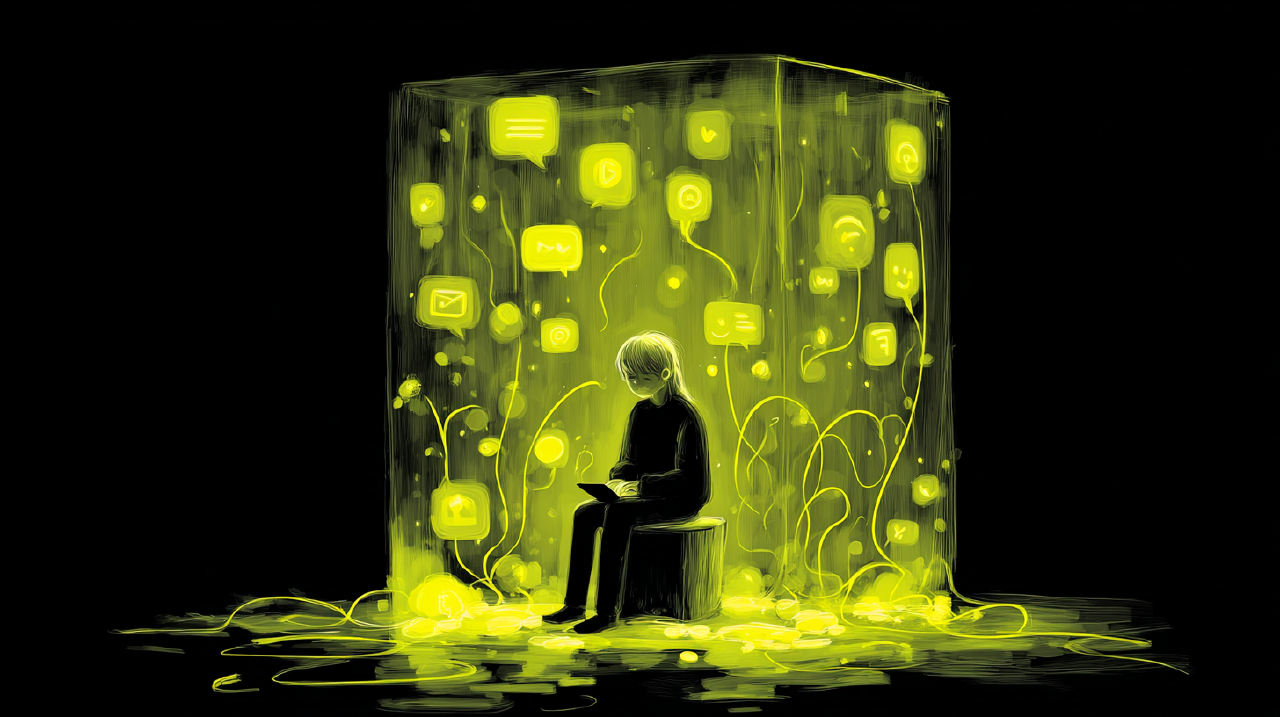




You open X to check one thing. Two minutes later you’re watching a public shaming ritual unfold in quote-tweets, a meme planted at the bottom like a flag in rubble.
You close the app. You feel worse about humanity. This isn’t a confession. This is the default route.
So when someone asks whether social media can foster deep connections, the honest answer is yes, but not on the main trail.
A meme can be a trail marker. It can be a flare. It can get you found. But it isn’t a campsite. Deep connection requires return trips, context, the boring miracle of being seen twice.
The problem is that our biggest platforms are engineered for motion, not for staying.
The meme is a compression device, not a relationship Link to heading
Memes work because they compress. A whole conversation folds into a small object you can throw across the network in a second.
This does two things at once. It makes recognition cheap and fast. It makes nuance optional.
If you’ve sent a friend the perfect image and gotten back “exactly,” you’ve felt the upside. The meme didn’t explain you. It didn’t have to. It was a handshake at highway speed.
Cultural critics sometimes treat memes as disposable. That’s lazy. Some are. Some are doing real work.
Apryl Williams’s analysis of “BBQ Becky” and “Karen” memes describes them as cultural critique, not internet dunking. Here’s the reversal: people who have historically been surveilled use humor to put the spotlight back on power 4 . That’s meaning-making. It is also community maintenance.
So the meme isn’t shallow by nature. It is shallow by budget. Optimized for a low-bandwidth moment.
But once memes become the main currency of public speech, you start paying for everything in coins. Even things that require paper. Even things that require a signature.
Memes can open a door. They can’t walk through it for you.
The feed isn’t neutral, and it isn’t your friend Link to heading
Now the part that stings.
X isn’t a timeline in any human sense. It is a sorting machine that decides what you see, in what order, based on what keeps you there.
That sorting matters more than any individual post.
A 2025 study in PNAS Nexus compared engagement-ranked timelines with reverse-chronological feeds for the same users. The engagement algorithm amplified more partisan content, more out-group hostility, and more negative emotion. When the researchers looked specifically at political tweets, anger was the dominant emotion amplified 1 .
Here’s the bleak-comedy detail: users did not necessarily prefer the political content the algorithm served them, even though engagement ranking kept them on the platform longer 1 .
The algorithm can make you stay longer while showing you content you like less.
This isn’t “people are addicted to outrage.” This is a system that learned what produces measurable behavior, then scaled it.
If you rank speech by engagement, you don’t just surface divisiveness. You subsidize it. You teach it to reproduce.
A platform is a climate. Content is the wildlife. Wildlife evolves.
That’s why the question “Can social media foster deep connections?” can’t be answered without discussing ranking. Love doesn’t scale on a leaderboard. Trust doesn’t go viral on purpose.
The feed is good at making you feel involved. It is much worse at making you feel known.
The audience is imaginary, but the consequences are not Link to heading
Even if the feed were neutral, the public surface of social media has a structural problem: flattened context.
Danah boyd’s work on networked publics describes why 3 . You can’t see who is watching. You don’t know which room you’re in, because the walls keep moving.
So you invent an audience. You speak to that invention. You shape yourself to survive in front of it.
That isn’t a moral failure. That’s navigation.
But it changes what people are willing to say.
In a flattened context, sincerity is expensive. Vulnerability is a high-risk asset. One bad interaction persists. It travels. It gets screenshotted. It gets remixed.
So people reach for safer objects: memes, tropes, irony, the shared wink.
This is part of why meme culture thrives on big public platforms. Memes aren’t just fun. Memes are survivable.
And survivable speech isn’t connective speech.
A relationship needs privacy and room to be wrong, to revise, to be unfinished. The public feed isn’t built for that. It is built for declarations that can be scored.
If you try to build intimacy in a stadium, you will end up performing. Even if you mean well.
When memes become coordinates Link to heading
Now the other side of the ridge.
Memes and short-form content can catalyze real community and action. In some cases, they are one of the few scalable tools ordinary people have.
Pew Research reports that 46% of social media users did at least one issue-based activity online in the past year: joining groups, encouraging action, sharing protest information, using political hashtags 2 . That isn’t all “deep connection.” But it isn’t nothing. It is the network functioning as a coordination layer.
The modern protest story is hard to tell without social media as a distribution system for evidence. Photos. Video. Screenshots. Receipts.
For a moment, the compressed object (a hashtag, a clip, a meme) becomes a coordinate. It points people toward a shared reality. It changes what can be seen. It helps people find each other.
That’s the good news.
The bad news is that the same compression that makes meaning shareable makes meaning easy to fake.
When solidarity becomes static Link to heading
If you want a clean example of short-form culture trivializing discourse, don’t look for teenagers dancing. Look for adults performing morality at scale.
Blackout Tuesday remains the clearest case study. Symbolic action becoming informational sabotage, with no one meaning harm.
A computational linguistics paper compared Blackout Tuesday posts to #BlackLivesMatter posts on Instagram 6 . The pattern was stark: Blackout Tuesday posts were shorter and more solidarity-focused. #BlackLivesMatter posts were longer and more explicit about white privilege. The hashtag network around #BlackLivesMatter connected to anti-racist activism hashtags. Blackout Tuesday connected more with popular culture and even #AllLivesMatter adjacency.
This isn’t a judgment about the intent behind every black square. It is a systems diagnosis.
A low-information symbol traveled farther than higher-information content. The symbol then flooded the channels people were using to share resources.
This is how shallowfication happens in practice. The platform rewards the most compressible artifact. A black square is the perfect compressible artifact: pure signal, almost no instruction.
It looks like participation. It is easy to post. Easy to like. Easy to count.
And because it is easy to count, it becomes the dominant thing.
If you are trying to build connection or sustain a movement, this is the nightmare scenario: attention without transmission. Volume without coordination. Everyone chanting. Nobody hearing.
The meme did its job. The movement had to clean up after it.
Where depth actually grows Link to heading
So where do deep connections reliably form online?
Usually not in the main feed.
They form in places with boundaries, repeated contact, and enough stability for norms to develop.
Purnima Malhotra’s work on “bounded social media places” focuses on low-visibility spaces inside broader platforms: private messages, private groups, servers, chats 7 . The core distinction is simple. These are places designed for intended audiences rather than mass address.
That distinction changes everything.
In a bounded space, you don’t have to speak like a brand. You can speak like a person. You can build a shared backlog of context. People notice if you disappear. You can apologize without a public trial.
This is the kind of environment where community can happen without a million views.
Even TikTok, the supposed temple of attention fragmentation, shows evidence of this dynamic. An interview study of U.S. TikTok users during COVID found that users treated the platform as a peer community where sharing lived experiences felt appropriate 9 . That isn’t the same as deep friendship. But it is closer to genuine social support than the stereotype suggests.
There are also more deliberate examples.
A 2025 paper on “algorithmic mutual aid” describes creators and audiences collaborating to redirect the value they generate on-platform toward specific people and causes 8 . They recognize the platform’s monetization logic and sometimes resist it. That isn’t just going viral. That’s a community learning the terrain and using the algorithm like a tool, not a god.
Still. Bounded spaces aren’t utopia. They can be warm. They can also be insular. They can harden beliefs. They can become echo chambers with better vibes.
Even the PNAS Nexus study has a caution: ranking by users’ stated preferences might reduce angry, hostile content, but it may also increase exposure to belief-reinforcing material 1 . Remove one distortion, another can appear.
Depth has risks. So does breadth. This isn’t a plug-and-play problem.
The tension we have to live inside Link to heading
If you want a clean verdict, I can’t give you one.
Social media can foster deep connections. People meet partners, collaborators, friends, long-term communities online. Movements form. Mutual aid moves.
But the primary public feed of major platforms is structurally hostile to the conditions that make depth common.
Possible, but uncommon.
The feed wants throughput. Connection wants return.
The feed rewards performance. Connection rewards repair.
The feed loves compressible symbols. Connection needs time-consuming context.
And ranking isn’t a detail. Ranking is the trail itself.
So the practical question isn’t whether memes can become meaning. They already do, sometimes.
The practical question is whether we can stop treating the feed as the place where meaning lives.
Use it for discovery if you want. Trailheads are useful. But don’t confuse the map for the land.
If you want depth, build smaller rooms. Choose spaces with boundaries. Use formats that force continuity: long threads, voice notes, calls, meetups, sustained projects, shared work. Things that score poorly on an engagement dashboard.
A platform can introduce you to someone. It can’t do the showing up.
Motion isn’t a life. The feed will keep trying to sell it as one.
The question is whether you keep buying.
Sources
- Engagement, user satisfaction, and the amplification of divisive content on social media Milli, Carroll, Wang, Pandey, Zhao, Dragan (2025) PNAS Nexus. 1
- Americans’ views of and experiences with activism on social media Pew Research Center (2023). 2
- Social Network Sites as Networked Publics: Affordances, Dynamics, and Implications danah boyd (2010) PDF draft. 3
- Black Memes Matter: #LivingWhileBlack With Becky and Karen Williams (2020) summary via Berkman Klein Center. 4
- #JusticeforGeorgeFloyd: How Instagram facilitated the 2020 Black Lives Matter protests Chang et al. (2022) open-access article. 5
- Divergent Discourses: A Comparative Examination of Blackout Tuesday and #BlackLivesMatter on Instagram Knierim, Achmann-Denkler, Heid, Wolff (2024) CLiC-it / CEUR Workshop Proceedings. 6
- Bounded Social Media Places Malhotra (2023) PhD dissertation, University of Washington. 7
- Taking back and giving back on TikTok: Algorithmic mutual aid in the platform economy Maris, Caplan, Thach (2025) New Media & Society (record page with DOI). 8
- How TikTok served as a platform for young people to share lived pandemic experiences Klug et al. (2022) MedieKultur (PDF). 9
- The Age of Surveillance Capitalism Zuboff (2019) publisher page. 10
- Algorithms of Oppression: How Search Engines Reinforce Racism Noble (2018) NYU Press. 11
- Amusing Ourselves to Death: Public Discourse in the Age of Show Business Postman (1985) Penguin Random House. 12
- In the Swarm: Digital Prospects Han (2017) MIT Press. 13