

You’ve seen it happen.
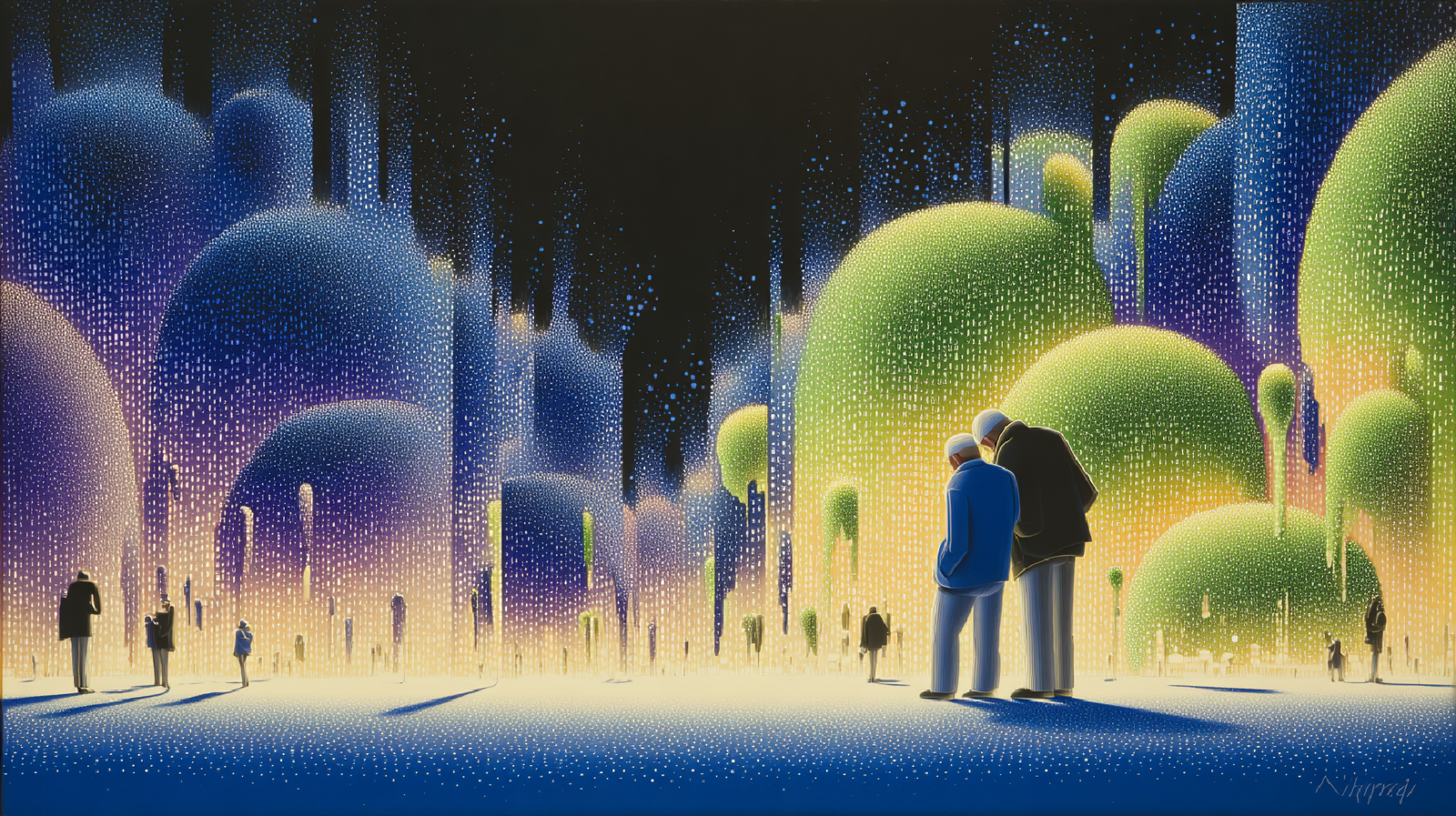
Someone types twelve words into a box. A new image appears: a scene nobody photographed, in a style nobody exactly painted, with lighting that makes your brain do that small involuntary nod. The nod you give when you don’t want to admit you’re impressed.
Then the second thought arrives, quieter: Where did that come from?
It doesn’t come from the keyboard alone, and it doesn’t come from you alone.
That’s the moment people reach for the dream metaphor. Midjourney “dreamed” it. DALL·E “imagined” it. Sora “hallucinated” a film clip with weather, shadows, and a camera move you’d swear was shot on location.
The claim here is simple: today’s generators produce dreamlike artifacts, but they don’t “imagine” in the way humans do. They do something adjacent, statistical reconstruction under constraints. Powerful, sometimes eerie, occasionally useful. But different in kind from what happens when a person stares out a train window and suddenly sees the solution to a problem they weren’t consciously solving.
This is where it gets tricky: both processes can look similar from the outside. You get novelty, coherence, even surprise. The outputs rhyme.
Similar outputs don’t imply similar mechanisms, and similar mechanisms don’t imply similar experience. Forgetting this can be catastrophic because if we forget this, we start treating generators as authors, asking them for truth, assigning them responsibility. We let metaphor drive decisions that need to be driven by mechanics.
So let’s build the map.
the unease is real Link to heading
You feel a tug to credit the system as an author, even when you know it’s a tool. You catch yourself wondering whether your own imagination is “just remix,” and the model is simply faster.
Those reactions aren’t silly. They’re your social cognition doing what it always does: trying to locate agency. Humans are built to detect “someone” behind behavior. We do it with pets, with cars, with the wind when it slams a door at exactly the wrong time.
The danger isn’t anthropomorphism. The danger is careless anthropomorphism: treating a generator like it has an inner life, then letting that assumption leak into decisions about truth, responsibility, and trust.
what imagination has meant Link to heading
Imagination is one of those words that behaves like a multi-tool. You can use it to cut bread, tighten a screw, or pry open a paint can. Then you argue about whether it’s “really” a knife.
Start with Aristotle, because he’s annoyingly modern here. In De Anima, he treats imagination (phantasia) as a capacity between perception and thought, involved in images, dreams, memory. The thing that lets something absent still move you. The world doesn’t have to be present for you to act as if it is. 1
That “as if” matters. It is more than pictures in the head; it is a bridge from sensing to doing.
Coleridge sharpens the split. He distinguishes “primary” imagination, tied to perception itself, from “secondary” imagination, the consciously creative power that dissolves and re-forms what we know. Then he contrasts both with “fancy,” closer to rearranging. 2
Three buckets people constantly confuse:
- imagination as perceptual world-making
- imagination as creative synthesis
- imagination as recombination and ornament
Most generative tools live comfortably in bucket 3, sometimes poke into bucket 2, and basically don’t touch bucket 1. They don’t perceive. They don’t inhabit a world. They don’t wake up with sand in their shoes and a plan that needs revising.
dreams are a workshop, not cinema Link to heading
A common story about dreams is that they’re nonsense: brain static, emotional residue, cheap surrealism.
There’s a more useful story: dreaming is part of how the brain integrates. During REM sleep, people get better at creative problem-solving, specifically at connecting weakly related information. One study found REM sleep enhanced the integration of unassociated information compared with quiet rest and non-REM sleep. 3
That’s a decent description of what generative systems seem to do: connect distant material into new compositions.
There’s also the planning angle. Hippocampal replay is the brain re-running and recombining experience in ways that support learning and future action. A recent theory paper frames planning as prefrontal–hippocampal interaction with replay. 4 The shape is familiar: simulate, score, update.
Human dreaming can lay groundwork for creativity. It recombines. It tests variations. It loosens the grip of literal reality.
Generative AI also recombines at scale. It produces “as if” worlds. It surprises you with coherent variations you didn’t request.
This is the point where people declare: “So it imagines.”
Here’s where you need to check the terrain.
what the math actually does Link to heading
The better claim: it’s all math, and the math is weirdly good at producing things that feel like imagination when you look only at the output. The trick is understanding which part is doing the work.
Modern language models ride on the Transformer architecture from the 2017 paper Attention Is All You Need. The core idea is self-attention: the model learns how each token relates to other tokens in context, then predicts what comes next. 5
Blunt metaphor: high-dimensional autocomplete with an expensive sense of context. You give it a prompt. It generates a continuation that statistically fits.
That can look like invention because the space of possible continuations is huge, and because sampling introduces variation. The model can “choose” a path that feels creative. But it’s not choosing because it wants a view. It’s choosing because the probability landscape and sampling settings push it there.
The model doesn’t have desire. It has a distribution.
Image and video generation often uses diffusion methods. Start with noise, iteratively denoise toward a sample that fits learned patterns. 6 You’ve seen the vibe: form condensing out of randomness. Looks like a dream coming into focus.
But the system isn’t “seeing” the image in the noise. It’s applying a learned denoising process that maps noise to data-like structure.
Sora treats video as patches in latent space and generates by learning patterns across space and time. 7 Whether you call it “world simulation” or “next-patch prediction,” the mode is similar: learn from a mountain of examples, generate plausible continuations under constraints.
Impressive outputs, often with an eerie sense of coherence.
Is this imagination, or fancy at scale?
the missing ingredient is stakes Link to heading
Here’s the simplest way to feel the difference.
A human dream can embarrass you. It can scare you. It can leave you with a mood that leaks into the next morning. Even when it’s absurd, it’s tethered to a life.
A generative model doesn’t have mornings.
It doesn’t protect anything. It doesn’t regret. It doesn’t carry a private wound that bends its creativity toward certain themes. It doesn’t live with the consequences of the output.
That doesn’t make it useless. It makes it different.
Ask Midjourney to render “a warrior’s last stand at sunset.” You’ll get dramatic lighting, compositional tension, perhaps a face that suggests resolve. What you won’t get is a system that has ever stood anywhere, or understood what it might mean to not stand again.
The image borrows the form of stakes without the weight.
two philosophical guardrails Link to heading
Dennett’s idea of the intentional stance: sometimes the best way to predict a complex system is to treat it as if it has beliefs and desires, even if underneath it’s mechanisms. 14
This is useful for prompting. Treating the model as an inner artist is a prediction strategy: “If I phrase it like this, it’ll ‘understand’ what I mean.”
The stance can make you effective. It can also trick you into treating the system as a moral agent, saying “the model decided to” when what happened was sampling plus your prompt plus training data plus interface defaults.
Use the stance. Don’t worship it.
Chalmers’ “hard problem” of consciousness draws a line between explaining functions and explaining subjective experience, the “something it is like.” 15 Even if a system behaved exactly like an imagining creature, that wouldn’t settle whether it experiences anything.
This blocks a lazy inference: “It outputs like imagination, therefore it imagines like us.”
the loop, not the node Link to heading
If relational views of mind hold any water (process philosophy, Buddhist dependent origination, Ubuntu’s “I am because we are”), then a useful possibility opens:
What we call “machine imagination” is actually distributed imagination.
It’s the human plus the model plus the dataset plus the prompt interface plus the culture of images we’ve absorbed. The “dream” isn’t inside the machine. It’s in the loop.
This reframes the question designers actually face: What kind of creative loop are we building, and who is responsible for what in that loop?
so is machine imagination real? Link to heading
Depends which meaning you’re using.
If you mean “produces novel, coherent artifacts,” yes, and improving fast. 10 11
If you mean “constructs counterfactual worlds to guide action,” today’s generators do a slice of that, but without the full loop of goals, memory, and consequence that makes human imagination more than decoration.
If you mean “has an inner experience of imagining,” we don’t have a clean test, and the outputs don’t settle it.
That’s the philosophical part.
Now the design part: if you’re building tools that claim “creativity,” you need something sturdier than vibes.
five tests for meaningful machine creativity Link to heading
Think of these as trail checks because it is easy to get turned around.
test 1: counterfactual coherence Link to heading
Can the system hold a stable imagined world while you change one variable?
Same character, different angle. Same scar, same clothing damage. Same room, different time of day. Objects stay where they were. Same scene, change one physical constraint: gravity lower, wind higher.
If identity and causal structure blur, you’re not getting imagination. You’re getting surface remix.
Try this: Write prompts that specify invariants explicitly, then vary one lever. Test whether the model can respect “this stays true” while exploring “what if.”
Failure mode to watch for: Midjourney V6 will confidently render a character with a facial scar in one frame, then lose it entirely in the next. The system has no stake in continuity.
test 2: constraint respect Link to heading
Can it be creative inside hard constraints without quietly cheating?
Hard constraints aren’t “make it cinematic.” They are: accessibility requirements, brand rules, physics limits, story logic, legal boundaries.
If the model’s “creativity” evaporates when you add constraints, it’s not creative in the way product teams need. It’s decorative.
Try this: Make constraints explicit and ranked. “Must,” “preferred,” “nice.” See what the system does when tiers conflict.
test 3: revision loop Link to heading
Can it improve its own output over multiple iterations using stated criteria?
A lot of demos are first-draft machines. Real creative work is revision.
Patrick Winston argued that a core separator in human intelligence is story competence, including the ability to notice when the story breaks. 20
Try this: Ask the model to generate, then critique against criteria, then revise. Keep the criteria constant. See whether changes are targeted or just more noise.
Turn taste into explicit rubrics. Not “better.” “Clearer causal chain.” “More consistent character motivation.” Then ask the model to self-audit before revising.
test 4: provenance and influence awareness Link to heading
Can you tell what the output is leaning on, and can you control that influence?
Here’s where “machine imagination” often falls apart in the real world. If you can’t assess what the model is borrowing, you can’t assess originality, bias, or risk.
Practical handles:
- controllable style influence
- controllable reference ingestion
- clear signals when echoing a known source too closely
Try this: Ask the system to describe its influences in plain language, then generate variants that move away from those influences while keeping core intent.
test 5: calibration and humility Link to heading
Does it know when it’s guessing, and can it express uncertainty usefully?
Creative work involves risk management: “this is a stretch,” “we need to test it,” “I’m not sure.”
Forecasting research treats calibration as a core virtue, tracked with scoring rules like Brier scores. 21 The metric is useful, but the habit is the point: track accuracy, update beliefs, don’t bluff.
A creative system that confidently invents fake references, or ignores constraints while sounding sure, isn’t imaginative. It’s reckless.
Try this: Force the model to rate confidence, name what falsifies its output, propose a quick verification step. See whether those checks are meaningful or cosmetic.
using the scorecard without theater Link to heading
A workflow that works:
- Pick one test as the focus of a sprint. Don’t do all five at once.
- Write three prompts that represent real work, not prompt-craft gymnastics.
- Run the same prompts across model versions or settings.
- Record failures in human terms. “It forgets who is in the scene” beats “identity drift.”
- Decide what you’re willing to ship. Sometimes “decorative remix” is fine. Just don’t sell it as imagination.
“Creative AI” can mean almost anything. The scorecard forces it to mean something testable.
more like a mirror than a dream. Link to heading
Algorithms produce outputs that look like dreams because both dreams and generators recombine fragments into coherent-seeming scenes. In humans, that recombination is welded to a living system with needs, memory, emotion, consequences. In models, it’s welded to training data, sampling, and the constraints you provide.
Machine imagination is real as a mirror. It reflects our culture back at us, compressed and reconstituted. Sometimes it shows you a pattern you didn’t notice. Sometimes it gives you a shortcut that frees your attention for higher-order decisions. Sometimes it hands you a counterfeit that looks like insight.
Stop asking whether the system “has imagination” as a trait. Start asking whether it supports an imaginative process that can survive contact with reality: constraints, revision, provenance, calibration.
That’s a question you can ship.
Sources
- On the Soul (De Anima), Book III Aristotle (trans. J.A. Smith, MIT Classics). Imagination (phantasia) as distinct from perception and judgment. 1
- Biographia Literaria, Chapter XIII Samuel Taylor Coleridge (1817, Project Gutenberg). Primary vs secondary imagination, plus the contrast with “fancy.” 2
- REM, not incubation, improves creativity by priming associative networks Cai et al. (2009, PNAS). Evidence that REM sleep can improve creative integration of weakly related information. 3
- A recurrent network model of planning explains hippocampal replay and human behavior Jensen et al. (2024, Nature Neuroscience). Planning as a prefrontal–hippocampal loop with replay. 4
- Attention Is All You Need Vaswani et al. (2017, arXiv). The Transformer architecture and self-attention. 5
- Denoising Diffusion Probabilistic Models Ho, Jain, Abbeel (2020, arXiv). Diffusion as iterative denoising from noise toward data-like samples. 6
- Video generation models as world simulators OpenAI (2024). Public description of Sora and patch-based representations. 7
- Version (Midjourney documentation) Midjourney (2025). Notes on V7 release timing and features. 10
- DALL·E 3 is now available in ChatGPT Plus and Enterprise OpenAI (2023). DALL·E 3 release context and mitigation stack. 11
- The Intentional Stance Daniel C. Dennett (1987, MIT Press). Treating complex systems “as if” they have beliefs/desires as a predictive strategy. 14
- Facing Up to the Problem of Consciousness David J. Chalmers (1995, PDF). “Hard problem” framing and limits of behavioral explanations. 15
- The strong story hypothesis and the directed perception hypothesis Patrick H. Winston (2011, MIT). Story understanding as a core ingredient of human intelligence. 20
- Identifying and Cultivating Superforecasters as a Method of Improving Probabilistic Predictions Mellers et al. (2015, PDF). Calibration and Brier-score-based evaluation. 21