

You don’t “join” TikTok communities the way you join a club.
You open the app. It opens a door.
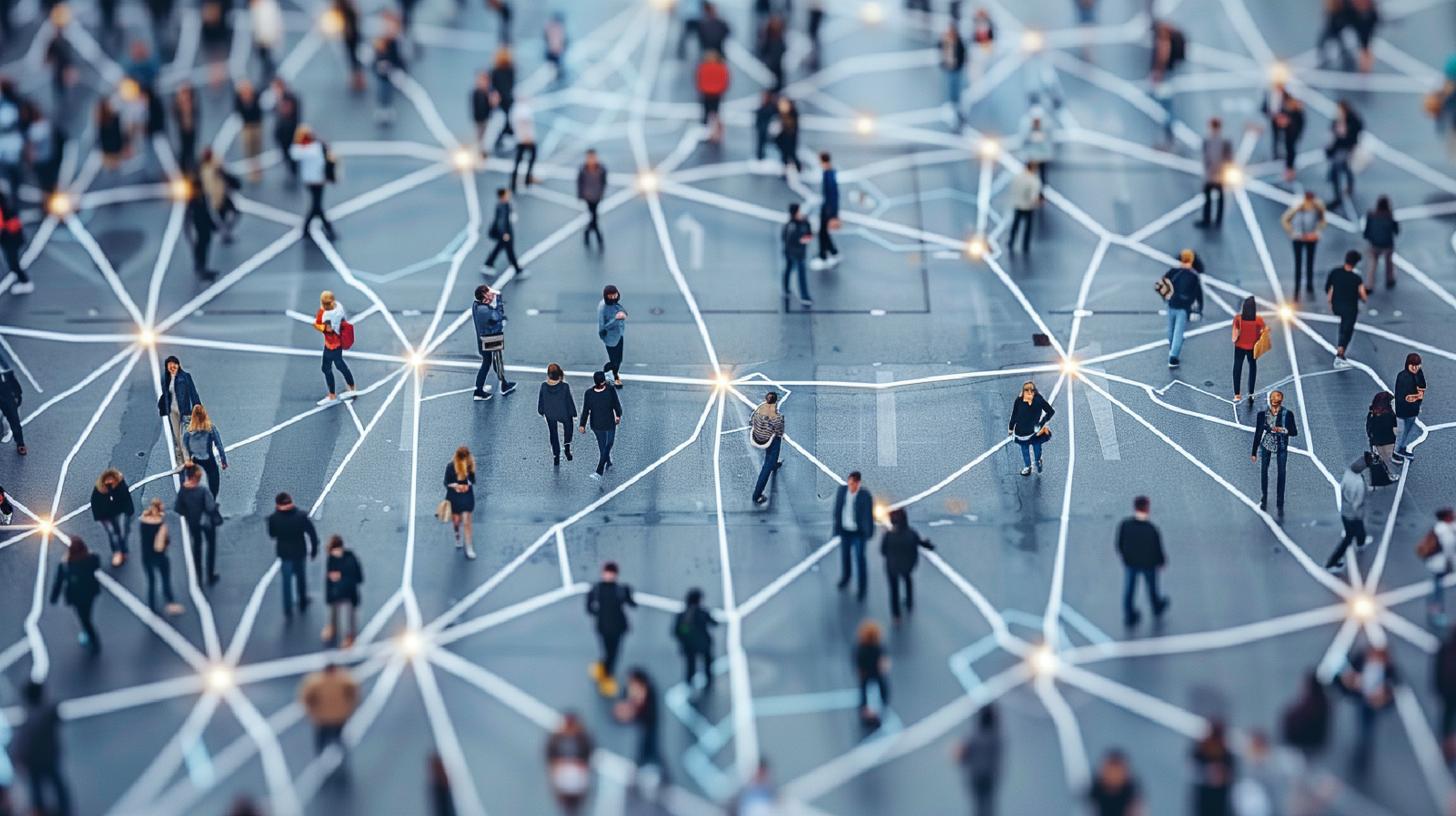
Within minutes you’re walking among strangers you didn’t pick, inside jokes you didn’t learn, arguments you didn’t agree to referee. Someone calls it “my side of TikTok,” like it’s a ridge line you can point to. They’re not being poetic. They’re describing routing.
TikTok treats community as a navigation problem. It doesn’t ask, “Who are your friends?” It asks, “What keeps you here?” Then it builds a world around that answer.
What makes it culturally distinct from the “follow your friends” era is the graph underneath. Facebook built on people you already knew. TikTok builds on what you watch. When your neighbors are chosen by shared watch patterns rather than shared history, you get fast intimacy with slow accountability. You can learn from a stranger for three minutes, feel genuinely understood, and never see them again.
Plenty of people have found something real this way. Someone with a rare diagnosis finds forty others in a week. A teenager in a small town finds out that people like him exist somewhere. That is not a small thing, and it is not a defense of the system that produced it, because the same routing that found those people for you also decides which strangers count as real to you today. You did not choose the routing. You cannot see it. Nobody outside the company can check its work.
This piece follows a chain that’s easy to miss while you’re scrolling:
Ranking decides what shows. What shows repeats until it’s normal. Normal hardens into belonging. Belonging becomes who you are. And who you are decides what you trust.
TikTok is the case study because it’s the clearest mainstream example of an interest-first feed. A timeline shows you what your contacts did. TikTok generates the terrain you walk through.
The chain Link to heading
Ranking decides what shows Link to heading
A feed is a decision. There is no “the internet” in your hand. There is a ranked list.
TikTok has been unusually direct about its basic inputs: watch behavior, likes, shares, comments, follows, plus weaker signals like device and location 1 . Wired adds a detail people feel but rarely name: TikTok tests videos with smaller audiences first, then expands distribution if people watch to the end 2 .
Technically that’s a ranking loop. Culturally it’s zoning. The system decides what counts as nearby, and in a feed, nearby is the whole of your social world. Ideas you never see are not ideas you disagree with. They are ideas that do not exist for you.
Two consequences matter.
First, the default is discovery-heavy. The system introduces you to strangers on purpose 1 . Niche communities form at speed. You can also be routed deep into a subculture before you have any context for what you are looking at.
Second, early signals are loud. A few minutes of watch time act like a trailhead sign, and the system reads your hesitation over one video as a statement about who you are. Once it believes you want that kind of thing, it keeps offering it, and every additional minute you spend confirms the guess it already made.
McLuhan’s point lands here with less mystery than usual: the medium is ranked selection 11 . The ranking is an editorial decision that nobody signs.
Repetition turns content into norms Link to heading
A community is more than shared interest. It runs on shared expectations.
How do we talk here? What counts as funny? What gets punished? What gets rewarded?
TikTok answers those questions by repetition. The feed ranks, then repeats, and repetition teaches norms faster than any community guidelines page ever will. The platform’s creative grammar speeds this up further: reuse a sound, stitch a clip, follow a template, swap in your own meaning. Participation costs almost nothing, so norms spread by copy-paste.
Repetition is a form of apprenticeship, which is exactly why it deserves scrutiny rather than applause. Watch ten variations on a skill and you learn the skill. Watch ten variations on a posture and you learn the posture. The mechanism does not care which one it is teaching. It teaches whatever the ranking surfaced often enough to look normal, and the ranking surfaces whatever holds attention.
So retention writes the curriculum. That produces a recognizable house style: speed, certainty, and the quick moral verdict delivered like a weather report. Postman warned that entertainment logic would swallow public life 12 . He was writing about television, and the mechanism he described got faster and more personal instead of going away.
Norms decide who belongs Link to heading
Once norms form, belonging follows, and so does exclusion.
A healthy community lets you be wrong in public on Tuesday and come back on Wednesday. Feeds are bad at Wednesday. The response to a misstep arrives all at once, from strangers, at a volume set by how well the misstep performs. A clumsy take that would have drawn three replies in a group chat draws thirty thousand quote-stitches, because the ranking rewards a pile-on with the same enthusiasm it rewards anything else that holds attention.
That changes how people talk before anyone corrects them. If the cost of a bad sentence is unbounded and the cost of a safe one is zero, you write safe sentences. If the reward for certainty is distribution, you perform certainty. Both are rational responses to a payoff structure that somebody chose and nobody voted on.
The gate is legibility. To belong you have to compress yourself into something the ranking can classify and the neighborhood can approve, and the compression is the part nobody mentions.
Belonging hardens into identity Link to heading
Once you belong, you start performing.
TikTok turns identity into a naming convention: BookTok, CleanTok, FinanceTok, TeacherTok. The labels help people find each other. They also tell people what to be consistent about, which is a heavier demand than it sounds. A label is a promise to keep producing the same self.
The loop is fast and public. You post, the feed responds, you adjust. Content that matches the neighborhood’s norms gets surfaced. Content that violates them gets ignored, mocked, or buried. Nobody issues an instruction. The platform shapes you for the community by reward alone, which works better than command because it never looks like an order.
This is Zuboff’s argument at a scale you can watch happening to yourself 14 . Her subject is the industrial harvesting of behavioral data, and the mechanism shows up in miniature every time you edit a caption to match what performed last week. You are adjusting your self-presentation to fit a classifier, in real time, for free.
Noble’s work on search engines makes the structural version of the point: systems that present themselves as neutral reproduce and amplify existing social bias, and they manage it while looking objective 13 . Search and recommendation are not the same machine, but they share the property that matters here. Whoever decides what gets seen decides what gets treated as normal, and at the scale of a feed, normal is culture.
Identity reshapes trust Link to heading
“Do algorithms polarize people?” is the wrong question. It asks for a yes or no about a system that behaves differently for every user. The better question is what kind of trust this environment produces.
Trust is not agreement. Trust is the working assumption that other people are real, that they have reasons, and that future contact is possible without humiliation.
TikTok now mediates a large share of public reality, and it does so in a format that carries almost no institutional signal. Pew finds TikTok users less likely than X or Facebook users to encounter news articles specifically 6 . A claim about a war arrives the same way a dance does: same vertical frame, same length, same production values. The format strips out the cues people use to decide how much weight something deserves.
The ranking has political shape too, whether or not anyone intended it. Ibrahim and colleagues audited TikTok’s recommendations during the 2024 US presidential race and found they skewed toward Republican-leaning content 5 . That preprint will be argued over, and the direction of the skew is the least interesting thing about it. What matters is that a system this consequential tilted, that the tilt was invisible to every person experiencing it, and that it took outside researchers running an audit to find. Next cycle it could tilt the other way, and we would learn about it the same way: late, and from strangers.
Ranking can also move feelings directly. A 2025 Science experiment reranked X feeds to reduce exposure to partisan animosity and measured a shift in how warmly people felt toward the other side 8 . Different platform, same lever. If turning the dial down warms people up, the dial has been sitting somewhere all along, and somebody has been choosing where.
Meanwhile trust in information from social media sits near one third and has not recovered 7 . That number reads as public cynicism. It is better read as an accurate assessment. People are not wrong to treat the information environment as hostile terrain, and hostile terrain does not grow thick social bonds. It grows hardened tribes.
What we can do about it Link to heading
Accept the chain (ranking to norms to identity to trust) and the interventions stop looking like moral lectures and start looking like engineering. Nobody is going to remove recommender systems. The work is to make community-shaping infrastructure contestable, steerable, and less obsessed with compulsive motion.
Offer real choice, not a placebo. The EU Digital Services Act requires very large platforms to provide at least one recommender option not based on profiling 9 . Choice only counts when the alternatives are usable, understandable, and presented as equals. A toggle three menus deep is decoration.
Show people the shape of their feed. Give users a readable neighborhood view: which clusters they sit in, which topics dominate, what moves when they act. Content controls are fine. Structural visibility is better.
Break topic lock-in on purpose. When a user signals “less of this,” the system needs to respond immediately rather than eventually. TikTok’s preference tools like Manage Topics and keyword filtering are a start 3 . Credible reset and cooldown modes are the next step.
Make pile-ons less profitable. Public shaming is a retention engine, so treat it like one. Platforms can already detect dogpiling and harassment dynamics, and they can reduce distribution accordingly. If that feels political, good. Community governance is political.
Fund independent audits, then tolerate the results. The DSA includes provisions for vetted researcher access to platform data 9 , and the European Commission has published guidance on how that access works 10 . If systems shape culture, society needs to measure that influence without asking the system’s owner for permission every time.
Move metrics closer to human outcomes. Watch time is easy to optimize and culturally blunt. A platform that claims to support community has to track community health: regret, harassment rates, concentration of exposure, satisfaction that survives a week. Some growth is just extraction with better lighting.
The missing agent Link to heading
When someone says “TikTok showed me my people,” they are telling the truth. They are leaving out the agent.
The agent is a ranking system that decided which people feel real to you today.
The questions worth asking are old ones wearing new infrastructure. What does the system make easy? What does it make unlikely? Who gets to contest the defaults?
Every community technology answers those questions, usually by never asking them out loud. The printing press answered them. The telephone answered them. The shopping mall answered them. The feed answers them at scale, in real time, while you scroll.
What is different now is speed and opacity. The feed decides faster than you can notice, the logic is proprietary, and the effects accumulate before they become legible. That combination is the argument for friction, and for a particular kind of friction: the kind that reveals rather than the kind that blocks. Surfaces that show you the shape of your own attention before it hardens into identity. Pauses long enough to ask whether this is where you want to be.
We are going to live inside these systems. So the walls should be visible, the defaults should be arguable, and the people who set them should have to say who they are. None of that is a large ask. It is only expensive to the companies currently not doing it.
Sources
- How TikTok recommends videos #ForYou TikTok Newsroom (2020) 1
- TikTok Finally Explains How the ‘For You’ Algorithm Works Laura Matsakis, WIRED (2020) 2
- More ways to discover new content and creators you love TikTok Newsroom (2025) 3
- TikTok rolls out AI-powered Smart Keyword Filters to limit content you don’t want to see TechCrunch (2025) 4
- TikTok’s recommendations skewed towards Republican content during the 2024 U.S. presidential race Ibrahim et al., arXiv (2025) 5
- How Americans get news on TikTok, X, Facebook and Instagram Pew Research Center (2024) 6
- How Americans’ trust in information from news organizations and social media sites has changed over time Pew Research Center (2025) 7
- Reranking partisan animosity in algorithmic social media feeds alters affective polarization Piccardi et al., Science (2025) 8
- Regulation (EU) 2022/2065 (Digital Services Act) EUR-Lex (2022) 9
- FAQs: DSA data access for researchers European Commission (2025) 10
- Understanding Media: The Extensions of Man Marshall McLuhan (1964) 11
- Amusing Ourselves to Death Neil Postman (1985) 12
- Algorithms of Oppression: How Search Engines Reinforce Racism Safiya Umoja Noble, NYU Press (2018) 13
- The Age of Surveillance Capitalism Shoshana Zuboff (2019) 14