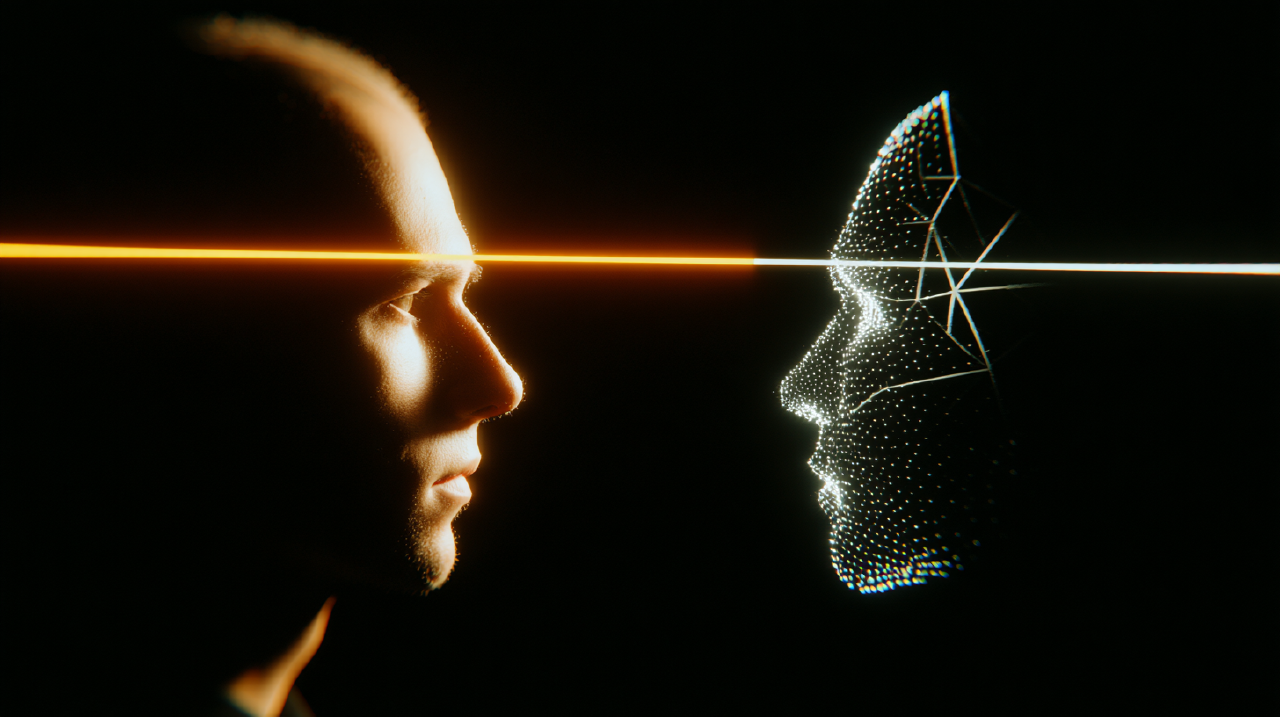




Everything is skimmable now. But what’s worth stopping for?
The cursor that lost its band Link to heading
I used to think I had beliefs.
Then I tried to write them down.
Not a thread. Not a take. Not vibes. Just plain sentences that would still look honest the next morning.
The cursor blinked like a metronome with no band left to keep. My brain did what it always does when asked for clarity: it reached for more input. A tab for context. A tab to verify. A tab to see what smarter people thought. Twenty minutes later I had a pile of sources and no idea what I believed.
This is the internet’s special talent: it helps you gather faster than you can digest. It hands you answers at highway speed, then acts surprised when you show up with no reasons and no direction.
Socrates had a word for this. In Plato’s Apology, he says the best thing a person can do is examine virtue, themselves, and others, and that “the unexamined life isn’t worth living.”
People quote that line like it’s wall art. It’s not. It’s a systems requirement.
If you can’t examine your life, you can’t steer it. You’re just being moved around by forces you don’t notice. These days, those forces aren’t only political or economic. They are also product surfaces.
So here’s the question I keep coming back to, usually while failing to write the sentence I meant to write:
When your day is built out of scrollable moments, what does an examined life even look like?
The feed gives you answers. It doesn’t give you reasons. Link to heading
A Socratic conversation has a shape. Someone claims to know what courage is. Socrates asks questions until the claim survives or gives way. The point is to replace confident fog with workable truth.
The feed flips that shape.
It gives you an endless parade of claims with no obligation to cash them out. You pick up a belief like a souvenir and drop it a few blocks later. No one asks you to define it. No one asks what would change your mind. No one asks if you live as if it’s true.
Herbert Simon nailed it in 1971, before the current circus was even legal to build: a wealth of information creates a poverty of attention.
A poverty of attention doesn’t only cost you productivity. It costs you yourself.
That matters for creative work, because creativity isn’t collecting interesting ideas. It’s committing to a line of thought long enough to discover what it actually says. And commitment is exactly what the skimmable internet trains out of us.
The default posture becomes: keep moving, keep sampling, keep optionality high. Never stay long enough to be wrong in a way that teaches you something.
I don’t think the internet did this out of malice. Malice would require more focus than the business model allows. It did it because “continuous partial engagement” is profitable and measurable, and “quiet internal revision” is neither.
But if you build systems, you should notice what your systems reward.
The tax you don’t see until your writing turns to mush Link to heading
The examined life requires basic cognitive conditions: sustained attention, working memory for competing interpretations, enough quiet to notice what you feel, enough continuity for meaning to accumulate.
The modern attention stack charges rent on all of these.
The phone wins by existing. Ward and colleagues tested what they called “brain drain”: your smartphone can reduce cognitive capacity even when you’re focused, even when it’s silent, just by being nearby. That matches lived experience in a way that makes you want to throw the phone into the ocean.
If you’re trying to think, “nearby” is still a relationship.
In backcountry terms, this is leaving food in your tent and insisting you’re not thinking about bears. You can be brave all night. Your nervous system knows better.
Interruptions raise speed, not depth. Gloria Mark found that people compensate for interruptions by working faster, at the cost of stress, frustration, and time pressure. The modern knowledge worker’s vibe: sprinting while seated.
You can ship a lot of messages this way. A lot of shallow agreement. A lot of performative certainty. What you can’t reliably ship is judgment.
Judgment is what happens when you let a thought run long enough to reveal its hidden assumptions. Interruption-heavy environments erode exactly that.
The feed is a task-switching gym. Rubinstein, Meyer, and Evans showed measurable costs in task switching. The feed trains the part of you that’s good at orienting to novelty. It neglects the part that’s good at staying with difficulty.
That’s why writing down what you believe can feel like walking uphill with a pack that didn’t used to be there. Your legs didn’t get worse. You changed what you train.
The cursor returns Link to heading
Somewhere around this point in the draft, I opened another tab.
I told myself I needed “one more source” to make the argument land. What I actually needed was to sit with the discomfort of not knowing what to say next.
The feed offers a trade: give us your uncertainty, and we’ll give you motion. The motion feels like progress. It isn’t. It’s just travel.
The cursor kept blinking. I closed the tab. I wrote a bad sentence.
Then I wrote a better one.
Deep reading is one of the last gyms for reflection Link to heading
There’s an argument that “reading is reading” and medium doesn’t matter. The evidence is messier.
Delgado and colleagues’ meta-analysis found reading comprehension often favors paper over screens, especially for complex text, especially under time pressure. This doesn’t mean screens make you dumb. It means screens come with affordances and habits that pull toward speed.
Maryanne Wolf has made the deeper point: deep reading isn’t automatic. It’s a cultivated mode that supports inference, empathy, and critical thinking. It can be displaced if we don’t practice it.
Here’s the link to the examined life: deep reading is one of the few mainstream activities that forces you to live inside someone else’s mind long enough to notice your own.
It’s slow. It’s inconvenient. It doesn’t fit the business model of “engagement.”
And it’s a decent approximation of what Socrates was doing all day: staying with a question until it changes you.
Silence isn’t absence. It’s integration. Link to heading
The examined life isn’t only argument. It’s also stitching.
Raichle and colleagues described a “default mode” of brain function, a baseline pattern that becomes less active during externally focused tasks. The practical point:
When you’re not feeding your mind new stimuli, it doesn’t go blank. It starts doing maintenance. It replays conversations. It runs counterfactuals. It notices emotions you were too busy to feel. It connects.
When every idle moment gets filled with a feed, you’re running your life without letting the system write to disk.
Then you sit down to write and wonder why your thoughts feel like loose cables.
The moral costume Link to heading
So far, this might sound like cognitive ergonomics. It’s not. It’s a moral problem wearing a UX costume.
Socrates wasn’t only worried about attention. He was worried about how you live.
For designers and AI researchers, this is where things get uncomfortable. Our systems aren’t neutral channels. They mediate experience. Post-phenomenology makes this explicit: technologies shape how humans relate to the world, not just what they can do in it. Tools don’t just add capacity. They tilt the whole apparatus.
This matters for autonomy.
Kant’s formulation: treat humanity, in yourself and others, always as an end and never merely as a means.
Translated into product reality, you get a sharp test: Are we building systems that help people act on reasons? Or systems that convert people into predictable response patterns?
Onora O’Neill has argued that modern talk of autonomy gets flattened into thin “choice,” detached from the conditions that make choice meaningful. You can “choose” on a dark pattern screen and still be managed.
A feed that keeps you skimming isn’t merely wasting your time. It’s training you into a version of yourself that can be nudged more easily.
That should bother you, even with excellent A/B results.
It should bother you especially if you work on AI, because prediction isn’t only a technical achievement. It is a power relationship. The better the system predicts, the more it can shape.
Here’s the moral line I use when I’m tempted to excuse this as harmless convenience:
If a system can’t feel regret, it should not get the steering wheel.
The Other isn’t content Link to heading
Levinas starts from a different place than Kant. Instead of rules and universals, he starts from the face-to-face encounter with another person, an encounter that makes a demand on you before you do any reasoning about it.
Online, we often never get the face. We get a proxy. A post. A compressed fragment.
The system invites a shortcut: reduce the person to a stance, then react to the stance.
This isn’t only a political problem. It’s a character problem: it changes what kind of attention you practice toward other humans. And practice becomes character.
Ubuntu puts it plainly: “A person is a person through other persons.” That’s not only descriptive. It’s prescriptive. Your attention has obligations. Treating people as disposable inputs isn’t a harmless hobby.
If your platform turns every encounter into a chance to score, dunk, or signal, it doesn’t only harm discourse. It harms your capacity to meet a human being.
An examined life isn’t only self-reflection. It’s a life that can still recognize the Other as real.
What to do without monastery cosplay Link to heading
I’m not interested in purity. I’m interested in results.
I want to write what I believe. I want to build things that don’t make other people’s minds brittle. I want my attention back as a basic condition for agency, plain and simple.
Here are practices I’ve tested. Not commandments. Not hacks. Constraints that make the terrain navigable.
Make one belief legible per week. If you can’t state what you believe in plain language, you don’t own it yet. Write one sentence you actually mean. Not your politics. Not your brand. Something closer to your operating system.
I believe most of my anxiety is prediction disguised as responsibility.
Then do the Socratic part: interrogate it. What do you mean by that word? When is it false? What would change your mind? What does it require of you tomorrow morning?
This is slow. Good. A feed gives you opinions at scale. This gives you reasons at human speed.
Treat the phone like a bear. Don’t fight brain drain with willpower. Use architecture. When you write, the phone goes in another room. If that feels extreme, notice how quickly “remove the primary distraction” gets labeled extreme.
Build endings. The feed is engineered without natural stopping points because endings are where people ask, “Was that worth it?”
Build them into your routines: a hard stop after a finite reading queue. A “close the loop” moment where you write what you learned in three sentences. A no-feed morning until you’ve produced something that came from you.
Designers should notice: endings aren’t UX polish. They’re ethical infrastructure. They return the user to themselves.
Use AI as a sparring partner, not a vending machine. AI makes skimmability more efficient. It can also make reflection more efficient, if you give it the right job.
When you feel a strong opinion forming, ask: What assumption am I making? What would a good-faith opponent say? Give me three interpretations of this situation that can all be true.
Then you decide what you endorse and why.
This isn’t outsourcing thought. It’s making your thought testable. If you’re building these tools, treat “help people generate reasons” as a first-class product goal.
The sharper Stoic line Link to heading
Epictetus begins the Enchiridion with a blunt distinction: some things are in our control and others are not.
People read that and think it’s about serenity. It is, but the deeper point is about responsibility.
Your attention is one of the few things that is meaningfully yours. Not perfectly, not constantly, not without effort. Still: it’s yours in a way your reputation is not, your metrics are not, your feed is not.
What you attend to shapes who you become. If you won’t choose it, someone else will. And they will not choose in your favor. They will choose in theirs.
This isn’t paranoia. It’s incentive alignment.
The cursor, one more time Link to heading
An examined life in the age of distraction isn’t a nostalgic return to candles and leather journals. It’s the stubborn act of staying inside a question long enough to become answerable for the life you are already living.
I still fail at this regularly. I still open tabs when the cursor blinks. I still confuse “more context” with “more clarity.”
But the failures have become easier to spot. That’s its own kind of progress.
The cursor blinks.
This time I write the sentence anyway.
Then I argue with it, like Socrates would.
Then I keep going.
Sources
- The Apology of Socrates (38a) Plato. Harvard Center for Hellenic Studies. 1
- Designing Organizations for an Information-Rich World Herbert A. Simon (1971). 2
- Brain Drain: The Mere Presence of One’s Own Smartphone Reduces Available Cognitive Capacity Ward, Duke, Gneezy, Bos (2017), JACR. 3
- The cost of interrupted work: More speed and stress Mark, Gudith, Klocke (2008), CHI. 4
- Executive control of cognitive processes in task switching Rubinstein, Meyer, Evans (2001), APA. 5
- Don’t throw away your printed books: A meta-analysis Delgado et al. (2018). 6
- Reader, Come Home Maryanne Wolf (2018). 7
- A default mode of brain function Raichle et al. (2001), PNAS. 8
- Kant’s moral philosophy Stanford Encyclopedia of Philosophy. 9
- Autonomy and Trust in Bioethics Onora O’Neill. 10
- Emmanuel Levinas Stanford Encyclopedia of Philosophy. 11
- Ubuntu: The Good Life Thaddeus Metz (2014). 12
- Postphenomenology Peter-Paul Verbeek. 13
- The Enchiridion Epictetus, MIT Classics. 14