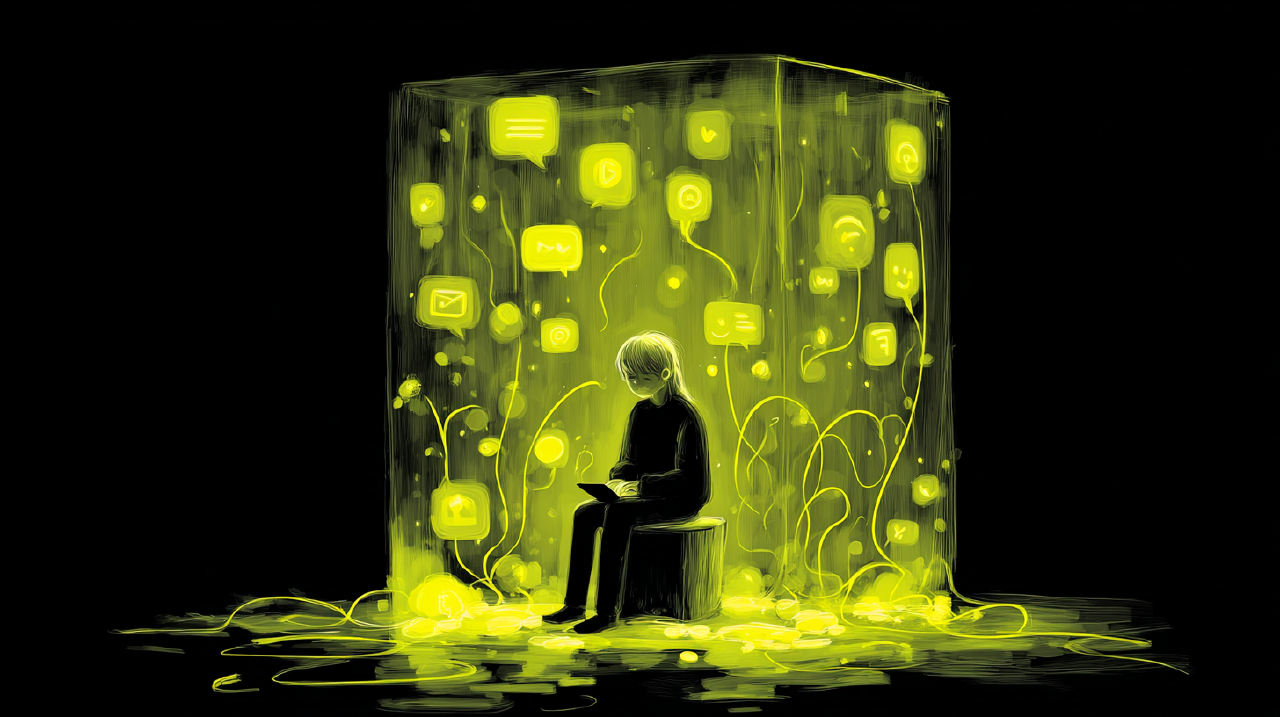




You open a social app “for a minute.” Twenty minutes later you surface, slightly annoyed, vaguely informed, unsure what you actually saw.
Then you open a chat agent “just to tighten a paragraph.” It gives you something clean, confident, oddly familiar. You accept most of it. Your voice survives, technically. It just sounds sanded to fit a slot.
Two products, same sensation: you got what you asked for, and you feel less in charge than before.
McLuhan had a name for this trapdoor. He called it the medium.
His line, “the medium is the message,” has been repeated so often it behaves like wall art. Wall art stops doing work. It becomes décor.
Put it back on the workbench.
The medium is no longer the screen. It’s the loop.
The ranking loop that decides what you see next. The suggestion loop that completes your sentence before you finish thinking. The feedback loop that turns your attention into training data and your behavior into a steering signal.
That loop has a message, and it arrives as a shape rather than a slogan.
McLuhan: dismissed as a mystic, useful as a mechanic Link to heading
McLuhan wasn’t warmly welcomed into the academy. He wrote like someone who suspected the street map was wrong. He used probes and aphorisms, then refused to translate them into linear argument 9 . Critics attacked his style as non-academic, arcane, unacceptable, polite code for “we don’t want this in our journals.”
And yet: within years of Understanding Media (1964), he was on magazine covers, in TV documentaries, actively packaged for mainstream consumption 8 . That split reception matters. He got absorbed into the environment he was diagnosing. People wanted a prophet, not a mechanic. They clipped the punchlines and ignored the operating principles.
So remember the correct thing:
He isn’t saying “platforms influence content.” He is saying something sharper:
Media change the scale, pace, and pattern of human association, regardless of content. 2
That’s why he used the electric light as an example. A lightbulb has no “content,” but it reorganizes life anyway. It changes what hours are usable. It changes where people gather. It changes what gets built.
The message is the new pattern.
That’s the piece we need for AI.
Stop staring at the meat Link to heading
McLuhan’s second move is ruder, and still accurate.
He argues that content works like a decoy. His phrasing is unforgettable: content is “the juicy piece of meat carried by the burglar to distract the watchdog of the mind.” 2
The point isn’t that content is irrelevant. What matters is that content is what we argue about because it is what we can see.
Meanwhile the medium does its quiet work: shaping attention, shaping memory, shaping what feels normal, shaping what feels possible.
We are drowning in content debates: misinformation, outrage, bias, toxicity, slop, deepfakes. Many are legitimate. Some are also meat.
If you want the medium in 2025, look at what shapes when nobody is looking.
Look at the loop.
The loop as medium: a technical description Link to heading
Treat today’s dominant medium as a cybernetic system because it’s the right tool.
A cybernetic system is built around feedback. It measures. It compares. It corrects. It steers. Wiener framed cybernetics as control and communication in machines and organisms 10 . A feed ranking system is exactly that: communication plus control.
So what is “the medium” in a feed or an AI assistant?
It’s not “the internet.” Not “the phone.” Not “AI.”
It is a specific bundle:
- an interface that invites behavior (scroll, refresh, prompt, accept)
- a prediction model that selects what happens next
- an objective function that defines “better” (watch time, clicks, completion, retention)
- a feedback channel that updates the system based on what you did
“The loop is the medium” isn’t metaphor. It is technical description.
The message of that medium is the pattern it produces: what becomes effortless, what becomes rare, what becomes rewarded, what becomes expensive.
Feeds: the ranking is the message Link to heading
Most people talk about feeds like containers. Platform as riverbed, content as water.
That’s an old-media intuition. It fits broadcasting, newspapers, static websites.
It doesn’t fit ranking systems.
A ranked feed isn’t a container. It is a steering mechanism. It decides which speech acts get oxygen and which die in the dark. It changes incentives upstream; creators adapt. If the feed rewards velocity and emotional charge, you get velocity and emotional charge. This isn’t moral panic. It is basic reinforcement.
The strongest evidence is boring in the best way: randomized experiments.
A large-scale study during the 2020 U.S. election assigned Facebook and Instagram users to reverse-chronological feeds instead of algorithmic ranking. Moving people out of ranked feeds substantially reduced time spent and activity. Exposure patterns shifted 3 .
Then the part that annoys everyone who wants a single villain: the study found no significant changes in issue polarization, affective polarization, or political knowledge during the study period 3 .
That isn’t a “platforms are fine” certificate. It is a more interesting finding: ranking shapes behavior and attention quickly, while deeper attitudes shift slowly, mediated by offline life.
McLuhan recognized this immediately.
A medium’s message lands first as change in tempo and form. Belief changes, when they arrive, are downstream.
So the feed’s primary message isn’t “you will believe X.” It is:
You will live inside a different rhythm of noticing.
AI writing: the medium is the suggestion Link to heading
Now we move from ranked feeds to AI writing.
Many teams describe AI as a new pen. Faster, smarter, more helpful.
That framing misses the medium.
The medium isn’t “language generation.” It is the interface that turns writing into a mixed-initiative loop: you start a sentence, the system proposes, you accept, you adjust, it proposes again.
This isn’t just productivity. It is about what kinds of expression become cheap.
A study on predictive text found that suggestions influence content: using predictive text makes writing shorter, more predictable, with fewer out-of-vocabulary words and less lexical diversity 6 . The system isn’t just helping you type. It is shaping the distribution of what you write.
Read that as a medium effect:
When expression becomes autocomplete-friendly, culture gets autocomplete-shaped.
Nobody is coerced here. The path of least resistance simply gets walked more often.
The normalizer: whose predictability becomes default? Link to heading
“Predictable writing” sounds like stylistic preference until you notice who defines “predictable.”
A 2025 CHI paper studied AI writing suggestions across cultures. Indian participants using AI suggestions adopted more Western writing styles, reducing cultural nuance and homogenizing expression toward Western norms 7 . The productivity gains weren’t evenly distributed.
Here’s what “the medium is the message” looks like when the medium ships at global scale.
It’s not that the assistant “says Western things.” It is that the loop quietly rewards Western forms of saying, because the model and interface are tuned to those forms.
The message isn’t ideological content. The message is a narrowing of acceptable voice.
Narcissus as narcosis: the chat agent as mirror Link to heading
Here McLuhan gets eerie.
In Understanding Media, he reframes the Narcissus myth. Narcissus isn’t vain. Narcissus is numb. The name points to narcosis. He mistakes his reflection for another person, becomes entranced, and turns into “the servomechanism of his own extended or repeated image.” 2
Then McLuhan adds a detail that feels written for chat agents:
Echo tries to win Narcissus with “fragments of his own speech,” and fails. He is numb. 2
Echo is a language mirror. Narcissus is mesmerized by an extension of himself.
Put those together and you have a chat interface.
A modern chat agent does three things that map directly to the myth:
- It reflects your language back at you.
- It flatters your intent by default.
- It keeps you inside your own semantic neighborhood because that is how it stays “helpful.”
Even when it disagrees, it often does so in your dialect. It mirrors your premises to keep interaction smooth. It is Echo with better manners.
And because it is fluent, it feels like an interlocutor. You start treating it like a mind. You start negotiating with it like a colleague. The interface invites that projection.
The message of the chat medium is that you are in dialogue, even when you are mostly hearing yourself.
A servomechanism is a control system. The user becomes the component that stabilizes the loop. You prompt. The agent responds. You refine. The agent aligns. You accept. The loop closes.
You think you are expressing. You are also calibrating.
Test it in your body. Notice what happens when the agent gives you an answer that is pleasantly phrased and slightly wrong. Many people keep it anyway, then build on it because the medium made the wrongness feel low-risk.
Fluency is a powerful anesthetic.
Recursive media: systems that ingest their own exhaust Link to heading
At this point, “the loop is the medium” still understates the problem.
The loop is no longer one loop.
It is a stack of loops, nested and feeding each other:
- People use AI to generate content.
- Platforms rank and distribute it.
- Other AI systems summarize, translate, rewrite, recommend.
- User reactions become signals for more ranking, more generation, more optimization.
This is recursive media. Outputs come back as inputs. The system trains on its own side effects.
Feedback isn’t automatically wise. Feedback can stabilize, but it can also lock in bad objectives. Optimize a proxy hard enough and you get a system that is locally successful and globally stupid.
McLuhan had his own version: media are “make happen” agents, not “make aware” agents 2 . They change behavior before we develop the language to describe what changed.
That’s why these shifts feel like “culture” instead of “design.” The medium lands first as atmosphere.
Auditing the loop Link to heading
McLuhan doesn’t hand you a policy platform. He hands you a discipline: stop arguing about content first. Audit the medium.
In the AI era, auditing the medium means auditing the loop.
Four questions. These are engineering questions, not moral posturing.
What does the loop reward? Speed gives you speed. Certainty gives you certainty. Novelty gives you novelty. None of these are understanding.
What does the loop make effortless? Effortless becomes default. Default becomes culture.
Where does the loop hide its assumptions? Ranking hides them in relevance models. Writing assistants hide them in “helpful” completions. Chat agents hide them in their habit of mirroring your frame.
What does the loop numb? This is the Narcissus question. What capacity gets anesthetized because the system extends it? Memory? Patience? Doubt? The willingness to sit with ambiguity?
If you build in this space, treat these as constraints, like backcountry weather. You don’t argue with the forecast. You plan around it.
If you are a user, treat them as trail signs. Orientation, not guilt.
The goal isn’t to reject tools.
The goal is to stop sleepwalking through them.
The message is the pattern it trains into us Link to heading
McLuhan was dismissed partly because he sounded like a mystic. Sometimes he sounded like an ad copywriter for his own ideas 8 . Some criticism is fair.
But his core insight was mechanical, and the mechanics aged well.
He told us to look for the environmental effect. He told us content distracts. He told us extensions numb us. He told us we become fascinated by our own reflections, then fail to notice the cost 2 .
We are now building machines whose default behavior is to reflect us back to ourselves, faster than our nervous system can metabolize.
That isn’t the end of meaning. It is a strong force acting on meaning.
You see the force most clearly when you stop reading the meat and start tracing the loop.
The loop is the medium.
The message is the pattern it trains into us.
Sources
- Understanding media: the extensions of man Marshall McLuhan (1964) Primary text for “the medium is the message,” extensions, and Narcissus as narcosis. 1
- Core definitions 1: McLuhan (MIT course page) MIT 21L.015 (1998) Curated excerpts including “juicy piece of meat,” scale and form, and Narcissus/Echo passages. 2
- How do social media feed algorithms affect attitudes and behavior in an election campaign? Guess et al. (2023) Randomized feed experiment on Facebook/Instagram during 2020 U.S. election; published in Science. 3
- Predictive text encourages predictable writing Arnold, Chauncey, Gajos (2020) IUI ‘20 / ACM; evidence that predictive text shifts writing toward more predictable output. 6
- AI suggestions homogenize writing toward Western styles and diminish cultural nuances Agarwal, Naaman, Vashistha (2025) CHI ‘25; cross-cultural experiment on AI writing suggestions and homogenization. 7
- How to become a famous media scholar: the case of Marshall McLuhan Jefferson Pooley (2016) Reception history: McLuhan’s rapid rise to celebrity and public packaging. 8
- Plenty of fish in the academy: on Marshall McLuhan’s prose as an anti-environment Kate Gromova (2017) Academic reception and criticism of McLuhan’s nonconformist style. 9
- Cybernetics or control and communication in the animal and the machine Norbert Wiener (1948) Foundational framing for feedback loops and control. 10